Most peer review findings do not occur because firms lack technical knowledge. They occur because quality processes are not applied consistently across engagements.
Most peer review findings do not occur because firms lack technical knowledge. They occur because quality processes are not applied consistently across engagements.
As an AICPA Peer Review Team Captain, I have had the opportunity to review firms of various sizes and observe both effective practices and common challenges. One lesson I have learned is that firms rarely receive findings because of a single engagement issue. More often, findings reveal broader patterns involving supervision, documentation, risk assessment, communication, and firm culture.
The firms with the strongest peer review results are not necessarily the largest firms or the firms with the most resources. They are typically the firms that have built quality into their daily operations long before a peer reviewer examines a file.
Peer Review Is Really About Consistency
For many accounting firms, peer review creates pressure long before the reviewer arrives. Teams begin revisiting files, updating documentation, checking independence forms, and reviewing whether engagements were completed in accordance with professional standards.
However, firms that consistently achieve strong peer review results approach the process differently. They do not view peer review as a temporary compliance exercise. Instead, they view it as a reflection of how the firm operates every day.
One common misconception is that peer review focuses solely on technical accounting accuracy.
Technical accuracy is important, but reviewers also evaluate whether a firm's policies, procedures, and professional judgment are applied consistently across engagements.
For example:
- Were risks properly identified and assessed?
- Were conclusions adequately documented?
- Was supervision clearly performed?
- Were review notes resolved appropriately?
- Did the workpapers support the final opinion?
A technically correct engagement can still receive criticism if the documentation does not clearly support the work performed.
Consistency is often the difference between a clean peer review and one that results in findings.
Documentation Often Reflects Firm Culture
Many peer review deficiencies are connected less to accounting mistakes and more to documentation habits.
In some firms, documentation is viewed as an administrative task completed at the end of the engagement. In stronger firms, documentation is treated as an integral part of professional judgment and engagement quality.
That difference can significantly impact engagement quality.
Common challenges arise when:
- Deadlines encourage shortcuts.
- Reviewers provide limited feedback.
- Staff hesitate to ask questions.
- Engagement teams rely too heavily on prior-year workpapers.
Over time, these habits create documentation weaknesses that peer reviewers quickly recognize.
Good documentation does more than satisfy professional standards. It demonstrates how professional judgment was applied throughout the engagement and provides evidence supporting the conclusions reached.
Smaller Firms Face Unique Challenges
Smaller firms often provide exceptional client service, but they also face unique quality risks.
Partners frequently balance multiple responsibilities, including client management, technical review, staff supervision, scheduling, and firm operations.
This concentration of responsibilities can create pressure that affects engagement quality if processes are not consistently followed.
Another commonly overlooked challenge is familiarity risk.
When firms serve the same clients for many years, engagement teams may unintentionally assume that processes remain unchanged. Risk assessments and planning procedures can become repetitive rather than being critically reassessed each year.
Peer reviewers often notice when workpapers appear overly standardized without sufficient engagement-specific analysis.
Technology Does Not Replace Professional Judgment
Many firms now utilize cloud-based audit platforms, automated templates, data analytics, and AI-assisted tools to improve efficiency.
These technologies can strengthen engagement quality when used appropriately. However, they also introduce risks when teams rely too heavily on automated outputs without fully evaluating the underlying information.
Peer reviewers increasingly focus on whether engagement teams demonstrated professional skepticism and independent judgment rather than simply completing required sections within software applications.
Technology should support quality—not replace critical thinking.
Quality Management Is More Than Compliance
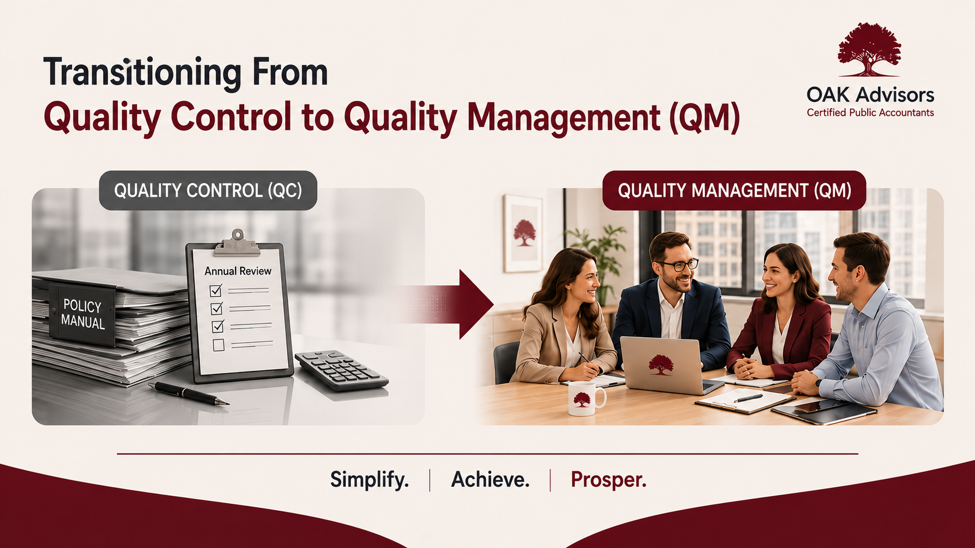
The profession's transition from traditional quality control standards to the new quality management standards represents more than a change in terminology.
Quality management requires firms to proactively identify, assess, and respond to quality risks. It emphasizes accountability, monitoring, continuous improvement, and a firm-wide commitment to quality.
The most successful firms do not view quality management as a compliance requirement. They view it as a business strategy that protects their reputation, improves engagement quality, develops stronger staff, and enhances client service.
When quality management becomes part of a firm's culture, peer review outcomes often improve naturally.
Leadership Sets the Tone
Ultimately, successful peer review preparation begins with leadership.
In my experience, firms with the strongest peer review results typically have leaders who consistently reinforce the importance of quality—even during busy seasons, staffing shortages, and client pressures.
That tone influences how staff approach planning, supervision, documentation, review procedures, and communication throughout the year.
Policies and procedures matter, but culture determines whether they are consistently followed.
Five Questions to Ask Before Your Next Peer Review
Before your next peer review, ask yourself:
- Are engagement risks clearly identified and documented?
- Is supervision evident throughout the workpapers?
- Are review notes resolved timely and appropriately?
- Are planning procedures tailored to the specific engagement?
- Do the workpapers clearly support the final conclusions and opinion?
If the answer to any of these questions is uncertain, the issue is often not technical knowledge—it is process consistency.
Final Thoughts
Peer review should not be viewed as a stressful event that firms try to survive every few years.
Instead, it should be viewed as a validation of a firm's commitment to quality.
The firms that perform best during peer review are usually the firms that prioritize quality every day, not just when a reviewer is scheduled to arrive.
In my experience as an AICPA Peer Review Team Captain, successful peer reviews are rarely the result of last-minute preparation. They are the outcome of strong leadership, effective quality management, consistent supervision, thoughtful documentation, and a culture that values professional excellence throughout the year.
What practices have helped your firm prepare for a successful peer review? I'd be interested in hearing what has worked well for other firms.