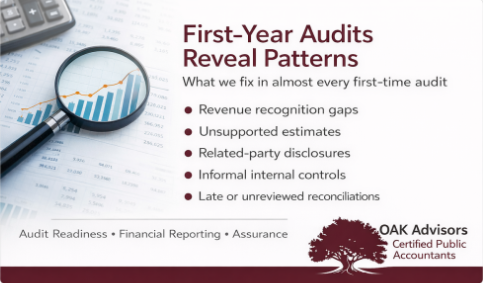
When a company undergoes its first financial statement audit, it's a significant milestone. However, first-year audits frequently uncover common patterns and areas for improvement.
Undergoing a first-year financial statement audit is a significant milestone for any growing business. Whether driven by new investors, a lender's requirement, or preparation for a future transaction, the initial audit process often serves as a stress test for a company's accounting function. Through our experience conducting these initial audits, we consistently observe several common patterns and areas for improvement.
1. Lack of Formalized Policies and Procedures
Many growing companies rely on the institutional knowledge of a few key employees rather than documented accounting policies. During a first-year audit, this often translates to inconsistent application of accounting principles or difficulty in explaining the rationale behind certain accounting treatments. Formalizing month-end close procedures and capitalization policies is a critical step in maturing the finance function.
2. Revenue Recognition Complexities
As businesses grow, their revenue models often become more complex. We frequently find that companies have not fully evaluated their contracts under ASC 606. Common issues include failing to identify distinct performance obligations, improperly deferring revenue, or lacking the documentation needed to support the timing of revenue recognition.
3. Inadequate Segregation of Duties
In smaller accounting departments, it's common for one individual to have overlapping responsibilities, such as having the ability to both process payments and reconcile bank accounts. First-year audits almost always highlight these internal control deficiencies. While hiring more staff isn't always immediately feasible, auditors can help identify compensating controls to mitigate the risks of material misstatement or fraud.
4. Complex Equity Transactions
Startups and growing enterprises often use complex equity instruments—such as convertible notes, warrants, or stock options—to attract talent and capital. The accounting for these instruments can be highly technical. First-year audits frequently reveal that these transactions have not been properly valued or recorded, requiring significant adjustments.
The Value of the First-Year Audit
While a first-year audit can be challenging and time-consuming, it provides immense value beyond the audit report itself. It acts as a diagnostic tool, identifying weaknesses in internal controls and financial reporting processes. At OAK Advisors, we approach first-year audits collaboratively, helping our clients understand these common patterns and implement the necessary improvements to build a stronger financial foundation for the future.