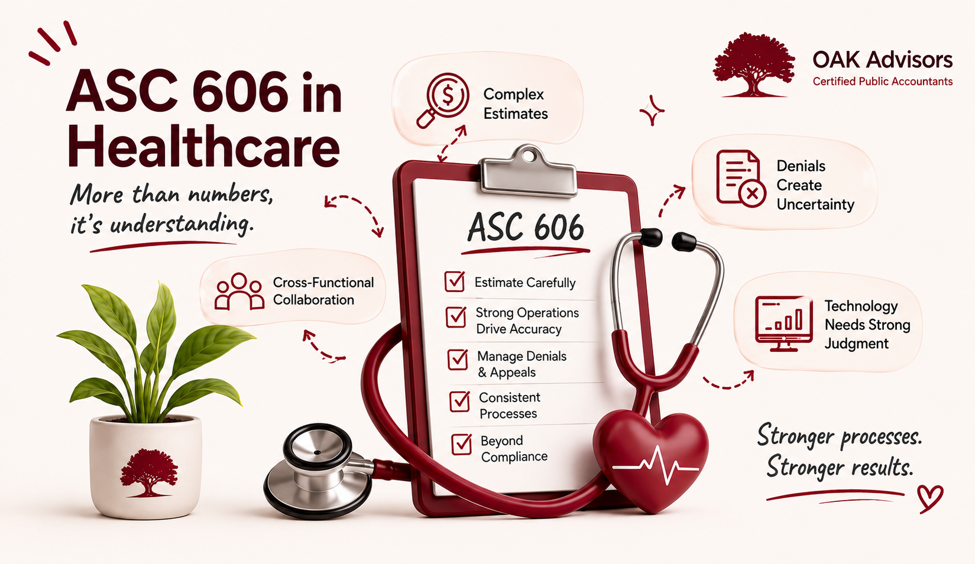
Implementing ASC 606 has fundamentally changed how businesses recognize revenue from contracts with customers. Navigating its five-step model presents unique challenges for growing enterprises.
Implementing ASC 606, Revenue from Contracts with Customers, has fundamentally changed how businesses recognize revenue. While the standard aims to create a more consistent framework across industries, navigating its five-step model presents unique challenges, particularly for growing enterprises with complex contracts.
The Five-Step Model Refresher
To understand the challenges, it's helpful to review the core five-step model required by ASC 606: 1) Identify the contract with a customer. 2) Identify the performance obligations in the contract. 3) Determine the transaction price. 4) Allocate the transaction price to the performance obligations. 5) Recognize revenue when (or as) the entity satisfies a performance obligation.
Challenge 1: Identifying Distinct Performance Obligations
One of the most complex areas is determining whether goods or services promised in a contract are distinct. If a business bundles software licenses, implementation services, and ongoing support, are these separate performance obligations or one combined obligation? The answer significantly impacts the timing of revenue recognition.
Challenge 2: Estimating Variable Consideration
Contracts often include variable consideration such as discounts, rebates, refunds, credits, or performance bonuses. ASC 606 requires businesses to estimate this variable consideration upfront and include it in the transaction price, subject to a constraint. Determining the most likely amount or expected value requires significant judgment and historical data analysis.
Challenge 3: Allocating the Transaction Price
When a contract has multiple performance obligations, the transaction price must be allocated based on the standalone selling price (SSP) of each distinct good or service. If an SSP is not directly observable, it must be estimated using methods like adjusted market assessment, expected cost plus a margin, or a residual approach. This allocation process can be highly subjective.
Challenge 4: Timing of Revenue Recognition
Determining whether revenue should be recognized over time or at a point in time requires careful analysis of the transfer of control. For services provided over time, businesses must select an appropriate method for measuring progress toward complete satisfaction of the performance obligation, which demands accurate tracking of costs or milestones.
Navigating ASC 606 with Expert Guidance
The complexities of ASC 606 require a deep understanding of both the accounting standards and the specific operational realities of your business. At OAK Advisors, our consultation and assurance teams help businesses navigate these challenges, ensuring compliance while optimizing financial reporting processes. We provide the expertise needed to implement robust revenue recognition policies that stand up to audit scrutiny.